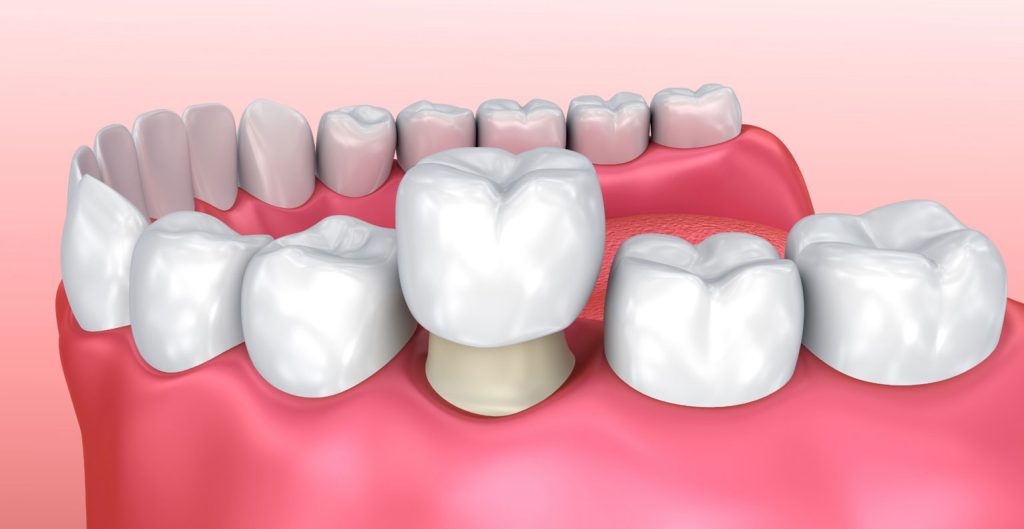
A dental crown is a custom-made cap that closely resembles a natural tooth and is used to restore a severely damaged tooth. Crowns restore the shape, size, alignment with neighbouring teeth, and strength during chewing.
When a tooth has lost a significant amount of its structure and cannot be restored with a filling, a prosthodontic restoration is required to fully rehabilitate the tooth.
Each crown is individually designed to match the anatomy of the specific tooth and to fully cover and protect it.
Materials Used for Dental Crowns
- Porcelain-Fused-to-Metal Crowns (PFM): Featuring a metal core made of nickel–chromium (Ni-Cr), silver–palladium (Ag-Pd) or gold (Au), covered externally with porcelain.
- All-Ceramic Crowns: Made entirely of porcelain, offering excellent aesthetics. However, they are generally more fragile compared to metal-ceramic and zirconia crowns.
- Zirconia Crowns: Either zirconia core with porcelain layering or full-contour zirconia. Zirconia is a modern, white ceramic material with high strength, superior to metals. It is biocompatible with the surrounding soft tissues, resistant to corrosion and fracture, and provides a highly natural, tooth-like appearance.
The Crown Placement Procedure
To place a dental crown, the tooth receiving the restoration is carefully prepared (shaped). An impression is then taken to create a dental model, which is sent to the dental laboratory for fabrication of the crown.
The process continues with shade selection, a trial fitting of the crown framework, and thorough evaluation of the fit and occlusal contacts. After final polishing and any necessary adjustments, the crown is permanently cemented in place.